Wednesday, May 31, 2006

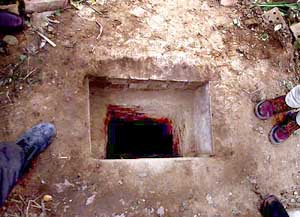
Ahmadinejad Spider-Hole Bound?


Mahmoud Ahmadinejad has rebuffed what will be, in all probability, the most reasonable offer for face-to-face talks with the U.S. that he's likely to get.

The United States said Wednesday it would join in face-to-face talks with
Iran over its disputed nuclear program if Tehran first agreed to put challenged
atomic activities on hold, a shift in tactics meant to offer the Iranians a last
chance to avoid punishing sanctions.

Iran dismissed the offer as "a propaganda move."

As I read this report, I couldn't help imagining a once-proud and intransigent Ahmadinejad, disheveled and covered in mud, being pulled out of his carefully concealed spider hole a la Saddam Hussein. I believe that Ahmadinejad, as Saddam did in 2003, is underestimating the resolve of his Western opposition. The difference is that the Europeans are all on board for this one, which makes the possibility of a military intervention increasingly likely.

Full story.

Tuesday, May 30, 2006

Letter sheds light on 1950 refugee deaths

President Truman pretends he doesn't hate Gen. MacArthur just long enough to pin him with The Distinguished Service Medal - Oct. 14, 1950, Wake Island.
More than a half-century after hostilities ended in Korea, a document from the war's chaotic early days has come to light — a letter from the U.S. ambassador to Seoul, informing the State Department that American soldiers would shoot refugees approaching their lines.

“If refugees do appear from north of US lines they will receive warning shots, and if they then persist in advancing they will be shot," wrote Ambassador John J. Muccio, in his message to Assistant Secretary of State Dean Rusk.
Source

This is the first I've heard of this story, and I don't think the Korean War would have lasted beyond its second year if it had been scrutinized as the war in Iraq is today. What chance will open societies have in future wars with the minute-by-minute coverage of combat now available to anyone with a TV or a computer? The Vietnam and Iraq wars are two good examples of how the toughest opponent a democratic nation's army can face is the one back home.

Der Spiegel Interviews Mahmoud Ahmadinejad

Here's an interview that Iranian president, Mahmoud Ahmadinejad, recently gave to the German magazine, Der Spiegel. I don't think there's any doubt, given his sustained anti-Israeli rhetoric, that Ahmadinejad is doing his best to derail any chance of peace between the Israelis and Palestinians.

SPIEGEL: Are you still saying that the Holocaust is just "a myth?"

Ahmadinejad: I will only accept something as truth if I am actually convinced of it.
Full interview here.

Ahmadinejad's persistent pandering to anti-Israeli elements in the Middle East makes sense when considering the intractable, ethnic strife within his own country, which has been building for longer than most realize:

During the last week of May, thousands of Iranians demonstrated in the northwestern city of Tabriz, and the previous week there were protests at universities in five cities. The protests were triggered by the official government newspaper - the Islamic Republic News Agency's Iran - publishing a cartoon which depicts a boy repeating "cockroach" in Persian before a giant bug in front of him asks "What?" in Azeri.

The recent incidents of ethnic tensions are only the latest examples of what has been escalating for more than a year. In mid-March in the southeast, which is home to many of Iran's 1.4 million Baluchis, a Baluchi group called Jundallah took responsibility for an attack on a government motorcade in which 20 people were killed. Jundallah seized a number of hostages and claimed that it executed one of them, a member of the Islamic Revolution Guards Corps. At least 12 people were killed in a similar attack in the second week of May. Nobody has taken credit for explosions May 8 in Kermanshah, which is home to Iran's 4.8 million Kurds, but the July 2005 shooting of a young Kurd by security forces led to demonstrations in several northwestern cities and the deaths of civilians and police officers. Since April of last year, there have been a number of violent incidents - including bombings that have targeted government facilities and which also have killed innocent bystanders - in the southwest, where many of Iran's 2 million Arabs live.
Source

Basic political doctrine dictates that domestic turmoil is best subdued by focusing attention away from it, and onto an external threat.

A Reader's Response

Repack Rider responds to my "Murtha Knows Best: Pronounces Marines Guilty Before Charges Filed in Haditha Scandal," post:


You seem to be confusing "verdict" with the observation that a crime has
taken place.

A "verdict" is an identification of a perpetrator, but that is the last
part of the question. When you find a bullet riddled corpse, or 24 of them
including children, you know a murder has taken place. That is not a "verdict,"
it is an observation of fact that is the initial stage of developing a verdict,
because you can't have a verdict until you know there was a crime. We also know
from the initial action reports that they were killed by United States Marines,
although the action reports told a different story about the events than the
evidence did.

If the story we are told conflicts with the physical and photographic
evidence, someone is lying, and someone is a murderer, but that is not a
"verdict." That is the starting point to the investigation leading to a verdict,
which would identify who is lying and who is a murderer.Thank you for this
opportunity to clear up what seems to be confusion on the right as to the
difference between observing that a crime has taken place, and the resulting
"verdict."


First, thanks for your cordial response, I’m always glad to receive polite feedback whether or not its conclusions are in agreement with my own.

In reading your response, I think it’s safe to say that you’ve taken issue with my characterization of Murtha’s comments as a verdict. Let me reiterate his comment here for clarity:


“Democrat John Murtha, a former Marines colonel who has retained close links to
the military despite his denunciation of the Iraq occupation, said Marines
"killed innocent civilians in cold blood."

Murtha is not simply pointing out that a crime may or may not have taken place; he’s instead unequivocally stating that the Marines in question have killed civilians in cold blood. The legal ramifications for committing such an act are defined locally as murder, and in an international context, as an atrocity against humanity, i.e., a war crime.

The point of this post was to indicate that some people who have come out against the war in Iraq, Murtha, in particular, have indeed declared these Marines guilty of a crime for which they have not yet been formally charged – I don’t honestly see any other way of interpreting Murtha’s statements. A declaration of innocence or guilt is a verdict; this is exactly what Murtha did, and I, for one, will never allow the presumption of innocence to be abandoned so willfully and irresponsibly, without expressing my strong disapproval.

As to your final point of clearing up “what seems to be confusion on the right,” I must respond by saying that the only confusion I see is that you've automatically assumed that I am from the right in the first place. Do you think that anyone who doesn't rant against the president and the war in Iraq at every opportunity is one of "those" people on the right? I surely hope not; such thinking is anathema to substantive debate.

The purpose of this site is to combat just that mode of thinking. My opinions about the war in Iraq and John Murtha’s selfish statements are based solely on my own analysis, and have nothing to do with an allegiance to any media-defined political philosophy. My goal here is to dismantle the artificial, groupthink-driven rhetoric, which regrettably passes for enlightened political thinking these days. So, with this in mind, let me thank you for giving me this opportunity to clear up your confusion.

Monday, May 29, 2006

A Marine Decries Murtha's Rush to Judgment

Regardless of how the investigation of the Haditha killings turns out, I think Rep. John Murtha has finally been exposed as the political opportunist that he is. The anti-war movement, if it expects to be taken seriously from here on in, would do well to distance itself from him as quickly as possible.

Here's a powerful letter to the editor of the Washington Post by Marine veteran Ilario Pantano, which underlines the irresponsibility of Rep. Murtha’s recent statements perfectly:

A year ago I was charged with two counts of premeditated murder and with other war crimes related to my service in Iraq. My wife and mother sat in a Camp Lejeune courtroom for five days while prosecutors painted me as a monster; then autopsy evidence blew their case out of the water, and the Marine Corps dropped all charges against me ["Marine Officer Cleared in Killing of Two Iraqis," news story, May 27, 2005].

So I know something about rushing to judgment, which is why I am so disturbed by the remarks of Rep. John P. Murtha (D-Pa.) regarding the Haditha incident ["Death Toll Rises in Haditha Attack, GOP
Leader Says," news story, May 20]. Mr. Murtha said, "Our troops overreacted because of the pressure on them, and they killed innocent civilians in cold blood."

In the United States, we have a civil and military court system that relies on an investigatory and judicial process to make determinations based on evidence. The system is not served by such grand pronouncements of horror and guilt without the accuser even having read the investigative report.

Mr. Murtha's position is particularly suspect when he is quoted by news services as saying that the strain of deployment "has caused them [the Marines] to crack in situations like this." Not only is he certain of the Marines' guilt but he claims to know the cause, which he conveniently attributes to a policy he opposes.

Members of the U.S. military serving in Iraq need more than Mr. Murtha's pseudo-sympathy. They need leaders to stand with them even in the hardest of times. Let the courts decide if these Marines are guilty. They haven't even been charged with a crime yet, so it is premature to presume their guilt -- unless that presumption is tied to a political motive.


ILARIO PANTANO
Jacksonville, N.C.
The writer served as a Marine enlisted man in the Persian Gulf War and most recently as a platoon commander in Iraq.

Sunday, May 28, 2006

Uribe Sweeps Election in Colombia

No surprise here:
BOGOTA, Colombia (AP) - Law-and-order President Alvaro Uribe was re-elected in a landslide Sunday in Colombia's most peaceful elections in more than a decade, strengthening the U.S. ally's mandate to crack down on armed groups and drug traffickers.
Full story.

A Contrast in Governments: Canadians Decisive in Illegal Immigration Policy

The Canadian government seems immune from the political inertia inflicting their American counterparts:
Canada's Conservative government took on a tough stance on illegal immigrants, having deported planeloads of undocumented workers since April.

Immigration Minister Monte Solberg has said the government "has an obligation to the hundreds of thousands of people waiting to get into this country to make sure we don't reward those who don't play by the rules.”


Full story here.

Murtha Knows Best: Pronounces Marines Guilty Before Charges Filed in Haditha Scandal

Although details are just beginning to come out concerning the alleged Marine massacre of between 15 and 24 Iraqi civilians in Haditha on November 19 of last year, it seems that some of the most outspoken detractors of the war in Iraq are unwilling to wait for a verdict before cashing in:

Democrat John Murtha, a former Marines colonel who has retained close links to the military despite his denunciation of the Iraq occupation, said Marines "killed innocent civilians in cold blood."

Andrew Murray, chair of the Stop the War Coalition, said: "It's clear that what happened in Haditha is a war crime. It would be idle to think this is the first war crime that has been committed in the last three years. It must be assumed that more of this is going on."

"What happened at Haditha appears to be outright murder," said Marc Garlasco of Human Rights Watch. "It has the potential to blow up in the U.S. military's face."

Source

If it is established that the marines under scrutiny did indeed commit the atrocities attributed to them, then let them feel the full weight of justice. However -- it should be noted that there have been no charges filed against any marine currently under investigation.

I believe John Murtha's statements were ponderously premature and irresponsible, and I wonder how many U.S. servicemen will die as a direct result of his agenda-driven rush to judgment.

Saturday, May 27, 2006

Bush Likens War on Terrorism to Cold War

President Bush, likening the war against Islamic radicals to the Cold War threat
of communism, told U.S. Military Academy graduates on Saturday that America's
safety depends on an aggressive push for democracy, especially in the Middle
East.

Here’s a quote from president Bush’s speech to the graduating class at West Point.
As President Truman put it towards the end of his presidency, 'When history says that my term of office saw the beginning of the Cold War, it will also say that in those eight years we set the course that can win it.' His leadership paved the way for subsequent presidents from both political parties - men like Eisenhower, Kennedy, and Reagan - to confront and eventually defeat the Soviet threat.
I entirely agree with the president's assessment, and wonder what isolationists would do differently to guarantee stability in the Middle Eastern oil market. I will be the first to say that Bush’s efforts in Iraq have been less than satisfactory, but I don’t think that his incompetence in prosecuting the war makes his overarching policy of stability via the democratization of the Middle East, any less valid.

Remember that Truman’s first substantial confrontation with communism in Korea was a nightmare. Truman had actually withdrawn all American troops from South Korea by 1949, which, as it turned out, was an open invitation for the communist North Koreans to invade. If Truman had been more resolute in his anti-communist convictions and maintained a strong military presence in South Korea, the war, in which 33,686 Americans perished, would never have occurred.

Will Illegals Have More Rights Than U.S. Citizens?

Thomas Sowell discusses the advantages illegal immigrants will have over American citizens if the U.S. Senate's immigration bill were to become law:
Since most of the illegals are Mexican, that makes them a minority. Under affirmative action, combined with amnesty, they would have preferences in jobs and other benefits.
Those who set up their own businesses would be entitled to preferences in getting government contracts. Their children would be able to get into college ahead of the children of American citizens with better academic qualifications.
Read the rest of Sowell's editorial here.

Go here for the full text of the senate's immigration bill.

Azerbaijan may supply gas to Europe, says president

Aliyev said Azerbaijan was also ready to play a role in the transit of oil and gas, citing two major pipelines nearing completion, which would take gas from his Caspian nation to Turkey and Georgia.

There’s no doubt that Azerbaijan could benefit immensely from a European contract as 49% of its population is currently living below the poverty line. The question that remains is whether the corruption endemic to Azerbaijan can be stifled sufficiently to allow it to become more than just another one-dimensional petrostate.

Full story here.

Friday, May 26, 2006

Feel-Good Legislation, But for Whom?


The Senate passed what could become the most sweeping immigration overhaul in two decades. The bill, which passed 62-36, includes stronger enforcement, a new guest worker program and a plan to allow many of the 12 million illegal immigrants now living in the United States to earn their way to citizenship.

Vicente Fox’s reaction:
Fox said the Senate vote was "the moment millions of families have been hoping for ... that millions of people have been working for."
Source.

Flashback:
The Mexican government drew fire from American advocates of tighter borders on Wednesday for publishing a pamphlet that instructs migrants how to safely enter the United States illegally and live there without being detected.
Source.

The Senate's passing of the immigration bill was, at best, a Pyrrhic victory. The watered-down bill will be rejected out of hand once it comes before the house. Vicente Fox’s strong support for the bill only makes this more likely.

Illegal immigration to the U.S., from Vicente Fox’s perspective, is nothing more than a political expedient; a safety valve, which reduces pressure on his government to make any serious economic reforms. This whole fiasco attests perfectly to the lengths that both American and Mexican politicians will go to retain their power.

Wednesday, May 24, 2006

DPRK Braces for War

Apparently, an American-led invasion of North Korea is imminent. Here's a recent offering by the DPRK's state run media:

Now that the U.S. move for a war of aggression against the DPRK has become undisguised, its army and people will further strengthen its self-reliant defence power in order to safeguard the security and sovereignty of the nation. The U.S., mindful of this, should immediately dissolve the illegal "UN Command" and take a measure for the withdrawal of its troops from south Korea.

Full text here. (Select the "U.S. Moves to Involve "Multi-national" Troops in Second Korean War under Fire" link from the main menu).

Avian Flu Update

There have been some significant developments of late, regarding the potent H5N1 flu strain. Healthcare officials have warned that human-to-human transmission of the so-called bird flu virus would have disastrous global health-care ramifications. Let's hope that no such transmission has occurred in Indonesia.

Jakarta - Tests have confirmed that two more people have died of bird flu in Indonesia, says a senior health ministry official.

One of the victims belonged to a Sumatran family at the centre of fears of human-to-human transmission after six members of the family died this month of bird flu.

Nyoman Kandun, director-general of communicable disease control at the health ministry, said: "One man from the same Sumatra cluster died this morning. He is the father of the child who died on May 13.
Read the full story here.


This is being reported out of Romania:

Bucharest - About 13 000 people were quarantined in the Romanian capital on Monday as troops and police sealed off streets in response to the city's second bird-flu outbreak, said officials.

The mayor of the southern fourth district, Adrian Inimaroiu, said residents would be cut off and all businesses in the area would be closed during the quarantine period of up to three weeks.
Story here.

Tuesday, May 23, 2006

In Range?


Iran conducted a test launch Tuesday night of the Shihab-3 intermediate-range ballistic missile, which is capable of reaching Israel and US targets in the region, Israel Radio reported. The test came hours before Prime minister Ehud Olmert met with US President George W Bush in Washington to discuss the Iranian threat.

Read the full story here.

Is this Israeli propaganda or Iranian provocation? My guess is that it’s probably a little of both. This renewed brinkmanship will more than likely push oil prices back over the $70 mark. Happy motoring.

The Iranian Badge Story Persists

It seems that this story will not die easily. Amir Taheri, author of the original article, which said that non-Muslims in Iran may soon be wearing identification badges, responds here to accusations that his claim is groundless. Here's an excerpt of his latest statement:


Regarding the dress code story it seems that my column was used as the basis for a number of reports that somehow jumped the gun. As far as my article is concerned I stand by it.The law has been passed by the Islamic Majlis and will now be submitted to the Council of Guardians. A committee has been appointed to work out the modalities of implementation. Many ideas are being discussed with regard to implementation, including special markers, known as zonnars, for followers of Judaism, Christianity and Zoroastrianism, the only faiths other than Islam that are recognized as such. The zonnar was in use throughout the Muslim world until the early 20th century and marked out the dhimmis, or protected religious minorities. (In Iran it was formally abolished in 1908).

Monday, May 22, 2006

It's the Oil, Stupid

Here’s the latest assessment of Iraq’s oil production capabilities according to James Jeffrey, senior advisor to the Secretary of State:
Jeffrey said oil production has been restored to over 2 million barrels per day. Iraqi oil exports are reaching 1.6 million barrels per day, and Jeffrey said he would like to see Iraq exporting 2 million barrels per day.
What were Iraqi production capabilities before the first Gulf war? Look here:
Shortly after its failed 1990 invasion of Kuwait and imposition of resulting trade embargos, Iraq's oil production fell from 3.5 million barrels per day to around 300,000 barrels per day. By February 2002, Iraqi oil production had recovered to about 2.5 million barrels per day. Iraqi officials had hoped to increase the country's oil production capacity to 3.5 million barrels per day by the end of 2000, but did not accomplish this given technical problems with Iraqi oil fields, pipelines, and other oil infrastructure.
Here’s a reference to a declassified British document showing Nixon’s resolve to break the Arab oil embargo in 1973:
The United States government seriously contemplated using military force to seize oil fields in the Middle East during the Arab oil embargo 30 years ago, according to a declassified British government document made public on Thursday.
The top-secret document says that President Richard M.Nixon was prepared to act more aggressively than previously thought to secure America's oil supply if the embargo, imposed by Arab nations in retaliation forAmerica's support for Israel in the 1973 Middle East war, did not end. In fact,the embargo was lifted in March 1974. The declassified British memorandum said the United States considered launching airborne troops to seize oil fields in Saudi Arabia, Kuwait and Abu Dhabi, but only as a "last resort."
The point to be made here is that oil is the lifeblood of the West, and that the current war in Iraq, whether you support it or not, was inevitable. Incompetence in the war’s prosecution does not invalidate the desired goal of stabilizing the Middle Eastern oil market.

Baghdad ER: It's About Time


As I watched the HBO documentary, Baghdad ER, last night, I was struck with the sense that this film would have more of an impact on how the war in Iraq is perceived at home, than any speeches, movies, or protests that preceded it. As the film clip showing Brig Gen. Nguyen Ngoc executing a Vietcong officer assaulted the sensibilities of Americans back home in 1968, Baghdad ER may have much the same effect in 2006.

It is vitally important for the American public to understand the tremendous sacrifices made by their countrymen in Iraq on a daily basis. In that regard, Baghdad ER is an important, albeit modest, step in the right direction. If your knowledge of the war in Iraq is limited to mind-numbing media abstractions, i.e., vague, politically motivated bombast, which does nothing to communicate the true carnage in Iraq, how can you possibly know whether the war is worth fighting?

Baghdad ER, as it turns out, did nothing to dissuade me from my previously held views on the war. What it did do, however, is significantly increase the appreciation I have for the profound sacrifices that have been, and continue to be, undertaken on my behalf. To all the U.S.,British, and Coalition forces serving in Iraq: Thank you.

Sunday, May 21, 2006

The Wealth of Nations

The Seattle Post Intelligencer ran an article yesterday reporting on China's completion of its Three Gorges dam across the Yangtze River. Apparently, this is the largest hydroelectric project the world has ever seen. This was, however, not what caught my attention. At the very end of the article there was a reference to China's growing wealth disparity, which piqued my interest:
Plans for a more elaborate celebration were canceled, Xinhua reported, without giving a reason. Elaborate state celebrations have been rolled back amid a growing disparity between the urban rich and rural poor.
Having, in recent years, heard a number of references to this troubling economic trend in China, I decided that it was about time I got to the bottom of things.

It turns out that the universally accepted statistic for measuring wealth disparities within a particular country is known as that country’s Gini coefficient. As I understand it, the Gini coefficient is a value between 0 and 1, with 0 meaning everyone in a particular country shares that nation’s wealth equally and 1 meaning, as you might expect, that a single person controls all wealth of that nation. Pretty straightforward stuff, right?

So, how well did China do? Well, the answer to that was surprising to say the least: China’s Gini index (the Gini coefficient multiplied by 100), it turns out, is 44, better than America’s, which is rated at 45! This, I believe, is a perfect illustration of media bias. Without looking more closely at the actual data associated with the above contention, there’s no doubt that many would have come away from that article with a much more negative opinion of China’s economic situation than appears to be warranted.

Here’s a link to a site that ranks countries by their Gini index. Remember, the lower the number, the more equal the distribution of wealth.

A Few Questions, Mr. President...


The British call it Questions to the Prime Minister; New Zealanders and Australians refer to it as Question Time; and the Canadians, as Question Period. These terms all describe the time set aside for the representative bodies of each of these nations to directly address any concerns they may have with decisions made by the chief executives of their governments. These question periods are an invaluable tool in establishing a transparent, democratic rapport between leaders and the people they are sworn to serve and protect. Conspicuously absent from this list is the United States of America. The president of the U.S. takes part in no such question period, and I believe it’s time for this to change.

There has been, since President Bush first took office in 2000, a progressively widening disconnect between the executive and his constituency. Approval ratings aside, the American president, regardless of his ebbing popularity at any given time, has chosen to greatly limit his public exposure. President Bush is more than happy to limit the debate by selectively feeding the media with carefully scripted sound-bites, specially formulated to fend off questions instead of answering them.

That participation in these tightly controlled presentations is generally limited to the media is equally vexing to me. The media does not represent me, so why are they given the exclusive privilege of questioning MY employee: the president?

In light of the myriad questions swirling around the president’s handling of the wars in Iraq and Afghanistan, illegal immigration, NSA wiretaps and official policies toward torture in the so-called war on terrorism, it is time for the president to make an accounting of himself.

I would like to have the president appear once a week before the U.S. Senate and once a month before the U.S. House of Representatives (The last week of each month would include the entire U.S. Congress). In these hour-long, publicly televised sessions, the president would take questions inspired by letters written to the congress by private American citizens. These sessions would be presided over by a member of the U.S. Supreme court; justices would serve in rotation and their power over the proceedings would be absolute.

Just imagine, all three branches of the U.S. government represented in the same chamber, locked in vigorous debate over the issues that WE, the people, think are important. I ask you, would this not electrify the American public? Never mind American Idol, such a spectacle would command ratings on par with the super bowl.

I firmly believe that the establishment of such a tradition would go a long way both in demystifying the American political process, and in giving the American people a much-needed assurance that their participation in government is not in vain. We get the government we deserve – It’s time to show that we deserve better.